
Why Hourly Mining Payouts Beat Monthly Settlement
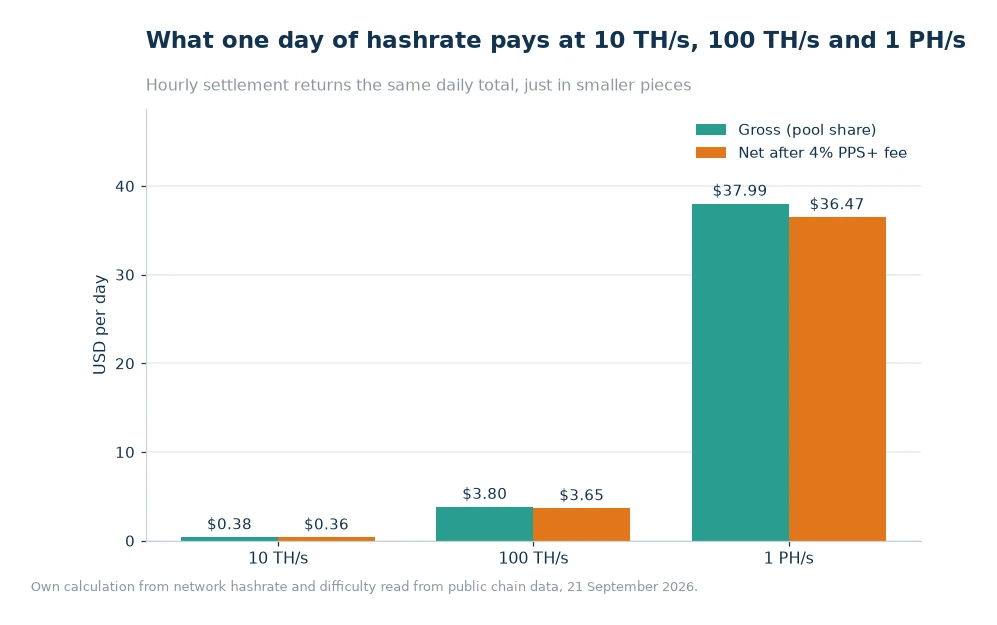
Settlement cadence does not change what you earn; it changes when you can use it. At current difficulty, 1 PH/s produces about 0.000449 BTC a day — $37.99 — and a monthly settlement schedule leaves that entire amount sitting with the operator until the end of the cycle, while an hourly schedule returns it in 24 credits of roughly 0.0000187 BTC each. On a farm with a power bill due every 30 days, that timing difference is the whole argument.
Key takeaways
- 1 PH/s earns about 0.0000187 BTC per hour ($1.58) under hourly PPS+ settlement, totalling 0.000449 BTC a day.
- Monthly settlement leaves 0.013458 BTC — about $1,139.80 per PH/s — unpaid and inside the operator's balance sheet at any moment.
- At 10 PH/s the same exposure reaches roughly $11,397.90, which is more than a month of hosting and power invoices combined.
- Cadence changes cash timing and counterparty exposure; it does not change expected income, which is set by your share of network hashrate.
The short answer
Hourly settlement wins on three counts that have nothing to do with the headline number. It shortens the window in which a payout is owed to you rather than held, it matches the payout curve to the electricity curve so an operating month funds its own costs, and it gives you 720 reconciliation events a month instead of one, which makes a hashrate fault visible within the hour it starts.
How the mechanism works
Under PPS+, the block-reward component is settled per accepted share against current difficulty and paid every hour; the transaction-fee component follows PPLNS logic at a listed 2% fee. PPLNS, by contrast, merges both components into one distribution triggered after a block the pool finds receives six confirmations, weighted by each miner's share of pool hashrate over the last five difficulty rounds.[1] The two mechanisms differ in who carries pool luck — the operator under PPS+, the miner under PPLNS — and in how long a reward stays unpaid after the work is proven.
What a shorter cycle changes
Two things, precisely. Counterparty exposure falls from a month of output to an hour of output. Working capital requirement falls by the same ratio, because the operator no longer has to advance power and hosting costs against income that has not been settled yet.
What it does not change
Expected value. Your share of network hashrate multiplied by daily emission is the same number whether it arrives once or 720 times. Any comparison that claims a settlement schedule changes gross income is describing variance, not return.
| Hashrate | Hourly credit | Daily total | Monthly total | Unpaid balance under monthly settlement |
|---|---|---|---|---|
| 10 TH/s | 0.0000002 | 0.0000045 | 0.0001346 | $11.40 |
| 100 TH/s | 0.0000019 | 0.0000449 | 0.0013458 | $113.98 |
| 1 PH/s | 0.0000187 | 0.0004486 | 0.0134582 | $1,139.80 |
| 10 PH/s | 0.0001869 | 0.0044861 | 0.1345818 | $11,397.90 |
Where miners get it wrong
Confusing cadence with method
Settlement speed is a property of the payment method, not a separate setting. PPS+ pays hourly; PPLNS pays when the pool finds blocks and the distribution window closes. A miner who wants predictable weekly cash should be looking at PPS+, not at a withdrawal schedule layered on top of PPLNS timing.
Assuming frequent payouts cost more
Mining payouts are not ordinary transfers, and this platform settles them with zero-fee mining withdrawals, so moving money out of the account does not erode the margin you calculated. What does cost money is a payout threshold set so high that small miners wait weeks for a first payment — worth checking before choosing a pool rather than after.
Treating volatility as a schedule problem
Hourly settlement smooths nothing about difficulty or price: it delivers a steadier cash curve from the same underlying economics. Miners who want lower variance in the reward itself should compare PPS+ against PPLNS, because that is where pool-luck risk gets transferred.
A worked example at 10 PH/s
Take a 10 PH/s farm of 20 J/TH machines. Power draw is 200 kW, or 4,800 kWh a day, which costs $288 at $0.06/kWh. Gross output is 0.0044861 BTC a day — $379.93 at $84,692 — leaving about $91.93 of daily margin before the listed fees on settled components.
Under monthly settlement, the operator finances 30 days of power — $8,640 — while 0.1345818 BTC ($11,397.90) of output accumulates unpaid. That gap has to be covered from reserves or credit. Under hourly settlement, credits arrive 720 times across the month, so the same power bill is paid from the same month's output, and the largest amount owed to the operator at any instant is 0.0001869 BTC — about $15.83.
There is a second, quieter benefit: an hourly credit is also an hourly heartbeat. If output at 1 PH/s should be 0.0000187 BTC an hour and a credit arrives short, you know something stopped hashing without opening a dashboard — the mining pool dashboard then tells you which worker went quiet.
Where the money goes next is a separate decision from when it arrives. A multi-currency wallet attached to the same account lets settled balance stay, convert, or leave in one place, which removes a transfer step from every sweep and keeps the payout history next to the balance it produced.
A checklist you can run today
- Write down your method. PPS+ pays hourly against current difficulty; PPLNS pays after six confirmations over the last five difficulty rounds.
- Compute the hourly rate for your hashrate: daily output divided by 24.
- Compare it with what actually arrived over the last 24 hours. A persistent shortfall is a hashrate or reject-rate problem.
- Size the exposure. Multiply daily output by 30 to see how much would be outstanding under monthly settlement.
- Check the payout threshold on any pool you are evaluating, especially for small hashrate.
- Align cadence with the power bill. If electricity is due monthly and payouts are monthly, you are financing the pool.
Operators who publish service terms make this comparison cheap. A platform such as ViaBTC Bitcoin Mining lists its fee components and settlement rules in public documentation, so the question "when does this money become mine?" has a written answer rather than an inferred one — which is exactly the standard worth applying before pointing hashrate at any pool.
Frequently asked questions
What happens if my miner goes offline?
Shares stop, so expected income stops with them. Alerts and a dashboard that shows per-worker hashrate shorten the gap between a failure and a fix.
Is a bigger pool always better?
Size reduces payout variance but also concentrates hashrate. What matters more is fee structure, uptime, latency and payout cadence.
Do hourly payouts mean more fees overall?
No. The listed fee applies as a percentage of the settled components, so paying 24 times a day instead of once a month does not multiply the fee rate. Mining payouts are also settled with zero-fee withdrawals.
Can I change settlement cadence without changing payment method?
Cadence follows the method: PPS+ settles hourly, while PPLNS distributes after the pool's block receives six confirmations. Choosing a cadence therefore means choosing the payment method that produces it.
Match the payout curve to the cost curve
Start with the number that matters operationally: your hourly credit at current difficulty, times 24, against your daily power cost. If the two curves are 30 days apart, you are carrying working capital you did not plan for. Move to a method that settles hourly, keep the arithmetic in a single sheet, and reconcile the credits once a week so a shortfall never survives more than a few hours.
Data and sources: ViaBTC pricing page for the listed PPS+ and PPLNS fees and hourly settlement rule[1], ViaBTC fee breakdown for how each fee applies to a payout component[2]. Network difficulty (132.76 T), network hashrate (about 1,003 EH/s), the 3.125 BTC block subsidy and the BTC price of $84,692 were read from public chain data and market feeds on 21 September 2026. Figures are illustrative and change with difficulty and price.