
Niche Fragrance Brands and OEM: Quality Control Checkpoints
Niche fragrance brands often expect looser quality control because their runs are small; the opposite is true — small runs make every defect more visible and more expensive. The checkpoints that protect a niche brand are the same ones the big houses use, executed in a leaner way: raw material identity, concentrate stability, batch-to-batch comparison and pack integrity. None of them requires a big team; all of them require a documented process on the factory side.
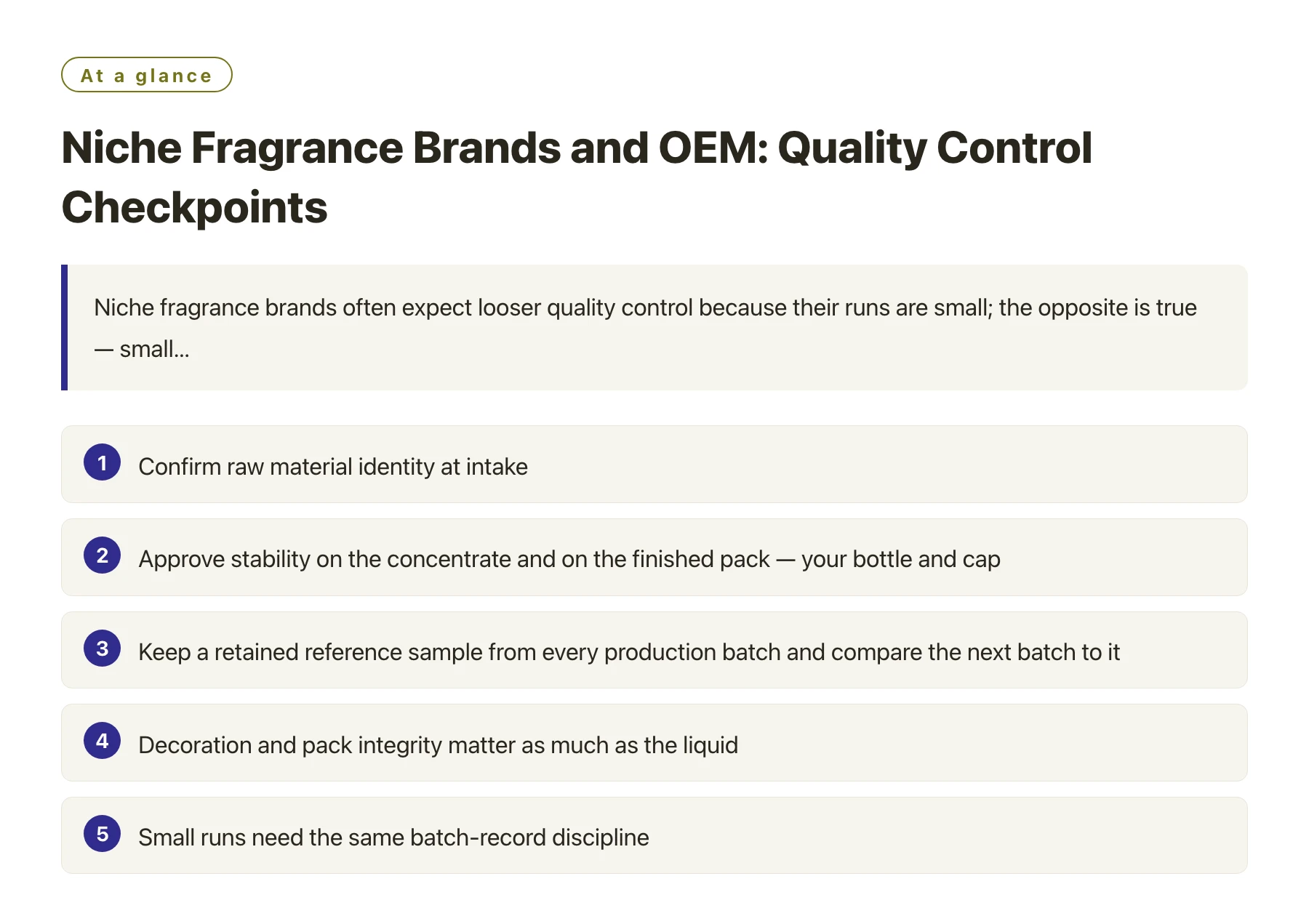
Key takeaways
- Confirm raw material identity at intake; a substituted material is the quietest way a batch drifts.
- Approve stability on the concentrate and on the finished pack — your bottle and cap, not the factory's show bottle.
- Keep a retained reference sample from every production batch and compare the next batch to it, blind.
- Decoration and pack integrity matter as much as the liquid; leaks and print defects are the first thing customers see.
- Small runs need the same batch-record discipline; the paperwork does not scale down with the volume.
Niche brands are founded on the promise of a distinctive scent and a personal relationship with the product — which is precisely why a single inconsistent batch hurts them more than it would hurt a mass brand with a dozen SKUs absorbing the noise. One bad batch, one refund, one negative review in a community that talks.
The answer is not a bigger QC department; a two-person brand cannot run one. It is a small set of checkpoints, agreed with the factory in writing, that catch the failures that actually happen. This article lists them in the order problems appear.
Why niche brands need stricter QC, not looser
The niche segment has been growing for years, and the rise of niche perfume brands has pushed factories to accept smaller runs with more exotic materials and tighter story-driven packaging — all of which raise the odds of a quality surprise the rise of niche perfume brands. A factory used to commodity volumes may treat a 500-unit run as marginal; the niche brand cannot afford that attitude.
Small volume also means small history: there is no decades-long file of resolved problems to lean on. The first few batches are the evidence base, so their records have to be clean. That is a documentation task, not an inspection task — the factory records each batch, and the brand verifies the pattern.
Checkpoint by checkpoint
| Checkpoint | What to inspect | Who owns the evidence |
|---|---|---|
| Raw material intake | Identity, purity, batch certificate per material | Factory QC; brand may request |
| Concentrate blending | Formula adherence and IFRA documentation per batch [1] | Factory, shared with the brand |
| Stability | Concentrate and finished pack over time | Third-party lab at launch |
| Batch to batch | Retained sample vs new batch, blind | Brand, against factory records |
| Pack integrity | Seal, cap torque, fill level, decoration | Factory QC at line level |
The left column is the order in which problems appear in practice; the middle column is the cheapest place to catch each one before it reaches a customer.
Making the checkpoints work at small volume
The retained sample as your benchmark
From every approved production batch, keep a sealed retained sample — labelled with date, batch number and formula reference — and use it as the benchmark for the next round. A retained sample is the closest thing a fragrance brand has to a written standard, because it embodies the smell, the colour and the intensity together.
Blind comparison, not memory
Compare the new batch against the retained sample without labels, and write the result down before you learn which is which. Memory of "how it smelled before" is not a quality standard; a blind test in a fixed format is. Two people, three time points, one grid.
Document what you check
A one-page record per batch — date, batch number, tester, result — beats a perfect memory. After a few batches you can see drift trends before a single customer complains, which is the entire point of checking instead of hoping.
Where the factory's process shows
Ask for the batch record on the first order, not the twentieth. A factory that produces a clean record without hesitation has the process; a factory that hesitates is showing you something important. If you want a third pair of eyes, independent laboratories such as SGS provide testing services across the cosmetics chain, and one stability report at launch is a reasonable entry point [2].
The factory's positioning is a signal of the QC depth you inherit. A manufacturer for luxury fragrance brands runs its quality process for customers who reject quietly inconsistent products, so the checkpoint burden on your side shrinks — but verify, because positioning is not evidence a manufacturer for luxury fragrance brands.
And if the line leans on the factory's own developed scents, remember that full ODM fragrance service transfers the factory's process to you: you inherit not only the scent but its quality history, stability data and batch discipline — or the absence of them full ODM fragrance service.
The marker of a mature OEM relationship is boring: the batch record of batch forty looks like the batch record of batch three. When the records start looking different, the quality conversation has already moved upstream — fix it there, not in the reviews.
Sources
- IFRA: Safe Use and Fragrance Science —— IFRA's explanation of how fragrance materials are scientifically assessed for safe use and how those conclusions are applied by the industry.
- SGS: Cosmetics, Personal Care & Household Testing —— Testing, inspection and certification services for cosmetics and personal care, including microbiological, stability and safety testing aligned with cosmetics GMP.
Frequently asked questions
Do small orders get worse quality control?
They can, if the factory treats them as marginal. Quality control is a process decision, not a volume decision — which is why the checkpoints above should be in writing regardless of order size.
How do I check batch consistency without a lab?
Retained samples plus blind comparison: keep a sealed sample from the approved batch, compare the new batch to it on a fixed grid, and record the result. That catches most drift before it becomes a customer problem.
Who pays for stability testing?
Usually the brand, sometimes split with the factory. Agree in the RFQ. One stability report at launch is a modest cost and it produces the evidence your market file needs anyway.
What should I do if one batch smells different?
Hold the batch, pull the retained reference, and run the blind comparison formally. If the difference is real, ask the factory for the batch record — the cause is usually traceable to a material substitution or a process change.
Is OEM or ODM better for a niche brand's quality?
Neither is inherently better. OEM gives you control of the formula and the QC burden; ODM gives you an existing, tested base and inherits the factory's track record. Choose by who you want to own the variability — and document the answer.
Ready to turn this into pipeline?
Book a 30-minute paid strategy audit with a senior strategist. We'll map your current spend, find the leaks, and model the 90-day lift.
Get My Free Strategy Audit