
OEM or ODM for a Gift and Travel Set: A Scope Checklist
OEM and ODM are not two price levels of the same service; they are two different scopes of work, and a gift or travel set exposes the difference because a single retail SKU contains several components. Under OEM you bring a developed scent and the factory produces it; under ODM the factory develops the scent as well. Choose by asking which workstreams in the set you can genuinely own — the formula, the components, the presentation packaging and the compliance file — rather than by comparing headline prices.
Key takeaways
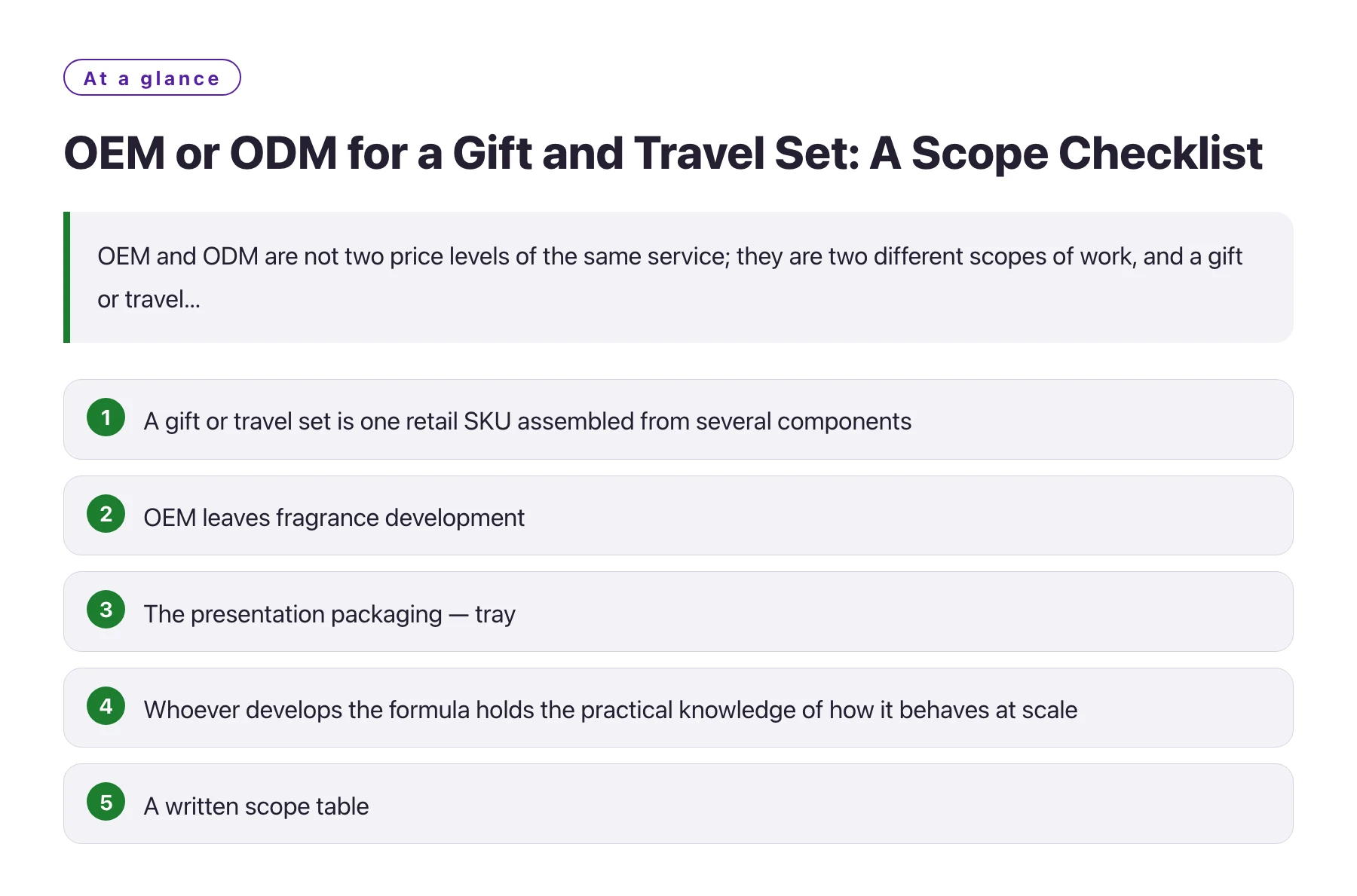
- A gift or travel set is one retail SKU assembled from several components, so the OEM/ODM decision belongs to each workstream rather than to the order as a whole.
- OEM leaves fragrance development, and usually packaging design, on your side of the table; ODM moves both into the supplier's scope.
- The presentation packaging — tray, insert, sleeve or rigid box — usually drives the set's cost and lead time far more than the fragrance load does.
- Whoever develops the formula holds the practical knowledge of how it behaves at scale, so ownership and handover terms should be agreed before sampling starts.
- A written scope table, signed before the first sample, prevents the most common dispute later: work that neither side believed it had agreed to do.
Most guides compare OEM and ODM as if a brand chooses once, for the whole company. In practice the choice is narrower and more practical: it is a decision about a specific product and a specific set of tasks.
A 30 ml travel spray and a five-piece discovery set pull in very different amounts of work. The spray is close to a standard filling job. The set brings trays, sleeves, shared cartons, kitting instructions and a retail specification that someone has to own.
This article sets out a scope checklist you can complete with a supplier on a call, and explains where the boundary between the two models usually lands.
Why a set makes the model choice harder
A single fragrance product is a bottle, a closure, a label and a carton. A gift or travel set adds a tray or moulded insert, a sleeve or rigid box, often a second format such as a travel spray or a small home fragrance piece, and an outer carton that has to arrive at retail intact. Each of those items can be specified by you, sourced by the factory, or developed end to end by the factory.
That multiplication is what makes the question concrete. With one bottle, a small brand can plausibly hold the whole specification. With a set, most brands find they can own one or two workstreams well and should hand over the rest. Suppliers that describe themselves as one-stop fragrance manufacturing typically cover several of those workstreams under one roof, which narrows the number of handovers but does not remove the need to define scope.
The commercial consequence is simple: two quotes for a set are comparable only if both were built on the same division of work. Price a set before the scope is fixed and you will be comparing different products.
The scope checklist, workstream by workstream
| Workstream | What you bring | Typical OEM scope | Typical ODM scope |
|---|---|---|---|
| Scent brief and formula | A finished formula, or a clear olfactive direction | Produces and scales the formula you supply | Develops the accord from your brief, then scales it |
| Format and fill | Decided formats and fill volumes | Confirms feasibility and fills to your specification | Proposes formats and fill volumes that suit the set |
| Bottle and closure | Selected models, or a design brief | Sources and fills the pack you chose | Selects from an existing pack range, or designs around it |
| Presentation packaging | Artwork, structure and printed components | Collates and packs the components you supplied | Develops the tray, insert or box with your branding |
| Kitting and assembly | Kitting instructions and a retail-ready specification | Picks, assembles and seals the set | Owns the kitting plan end to end |
| Compliance file | Destination-market requirements and product claims | Supplies batch and technical documentation | Builds the file around the formula it developed |
| Exclusivity of the scent | Decides whether the scent must stay exclusive | Only what the contract states | Negotiable, and usually priced into development |
The pattern is consistent: the further down the list you go, the more ODM absorbs, and the more the factory's own component range shapes the finished set. Where the whole programme sits with one supplier, as it does at Xuelei Fragrances, the scope table is still worth writing, because it shows what the price includes rather than what the brochure covers.
Where the boundary actually sits
Ownership follows development
The party that develops a formula normally holds the working knowledge of how it behaves when scaled, how it ages in the chosen format and which materials are load-bearing. That does not have to mean ownership, but it does mean the handover terms matter: what you receive, in what form, and on what conditions if you move production later. Design and formula rights are negotiable commercial terms rather than technical facts, and they are exactly the kind of asset that intellectual property systems exist to register [3].
Presentation packaging is the schedule
Rigid boxes, moulded inserts and printed sleeves carry tooling and print lead times that can be longer than fragrance development. Under OEM you usually own that schedule and the risk attached to it; under ODM you own less of it, and you should still ask to see the component list and the critical path so the launch date is not a surprise.
Compliance is a shared file, not a handover
Fragrance materials are restricted by published industry standards whose limits depend on how a product is used, so the formula and the finished format have to be assessed together rather than separately [1]. Gift packaging then falls under its own rules in markets such as the EU, where packaging design and recyclability requirements are set independently of the product inside [2].
Decide per set, not per brand
A brand can run an exclusive OEM signature scent and an ODM discovery set at the same time. The models coexist comfortably. What does not coexist is an unclear scope on a single SKU. A partner that operates as a manufacturer that supports OEM and ODM can move tasks between the two modes without changing supplier, which is useful when a first set is expected to become a permanent range.
The practical test is to name the person responsible for each line of the scope table. If two names appear, the workstream is not yet defined.
Before you request prices, write the scope table for your own set and mark every line as we own it, they own it, or not decided. The third answer is where quotes come back incomparable and where a programme quietly loses weeks.
Sources
- IFRA Standards Library (International Fragrance Association) —— The IFRA Standards Library lists the restrictions the fragrance industry applies to individual fragrance ingredients, based on safety assessments; it is the reference point for compliant fragrance formulation.
- European Commission: Packaging Waste and the PPWR —— EU rules on packaging and packaging waste, including the Packaging and Packaging Waste Regulation requirements on recyclability and design.
- WIPO — World Intellectual Property Organization —— The UN agency for intellectual property; resources on industrial design and patent protection relevant to product and packaging design.
Frequently asked questions
Is ODM more expensive than OEM?
Not inherently. ODM usually bundles development into a development fee or a unit price, while OEM assumes development has already been paid for elsewhere. Compare total cost for the same finished set, including components, kitting and assembly, rather than comparing the two models in the abstract.
Can I use ODM development and still keep the formula exclusive?
Sometimes, but exclusivity is a commercial term rather than a technical one. It should be negotiated and written down before development starts, because it affects whether the same accord can be offered to another client.
Do I need to own a bottle mould for a travel set?
Only if the shape is central to the brand. Many sets are built on existing pack ranges, which removes tooling cost and a long tooling stage from the schedule. A custom shape usually pays off only when the pack appears across the whole range.
Who writes the compliance documents for a gift set?
In most projects the factory supplies technical and batch documentation while the brand owns market-facing claims and registration. Because that split varies by market, list it explicitly in the scope table instead of assuming it.
How many components should a first set contain?
Enough to tell the story and few enough to keep kitting and packaging manageable. Every additional component adds a supplier, a drawing, a tolerance and a quality check, and each one can move the launch date.
Ready to turn this into pipeline?
Book a 30-minute paid strategy audit with a senior strategist. We'll map your current spend, find the leaks, and model the 90-day lift.
Get My Free Strategy Audit